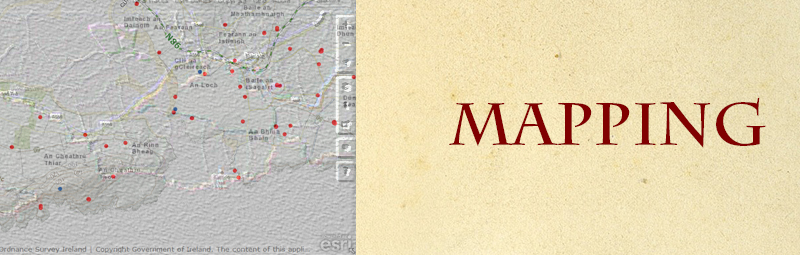
A community map is a map produced collaboratively by residents of a particular locale, often featuring local knowledge and resource, it opens up cartography to the amateurs, and asks participants to share experience values and visions about particular places [Parker 2006].
Ogham Stones in Mindcraft
In order to explore the potential of different generations, that could potentially participate in a community-based archaeology project, such as Ogham in 3D, or a different learning terrain, such as an exhibition in a library, I have been looking into Mindcraft.
Learning as Hyperbolic Chaos
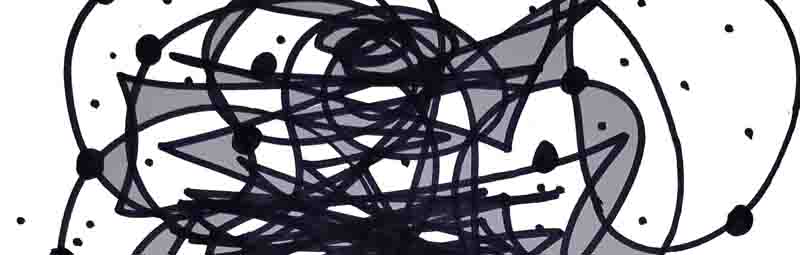
Just a few weeks before my MA thesis was due, I was researching for diagrams of learning models, in particular related to Digital Literacies. I had an idea of a model in my head, but I couldn’t seem to find one that suited what I was trying to say. I wanted to find a learning model that was not angular, A > B, or cyclical, A > B > C > A > B > C…… Of course, new lines of thought, are not a good idea in the last few weeks of a thesis, but it was a nagging one and I had to explore it, albeit briefly. In my thesis, it was just a brief paragraph.
Ogham in Animation
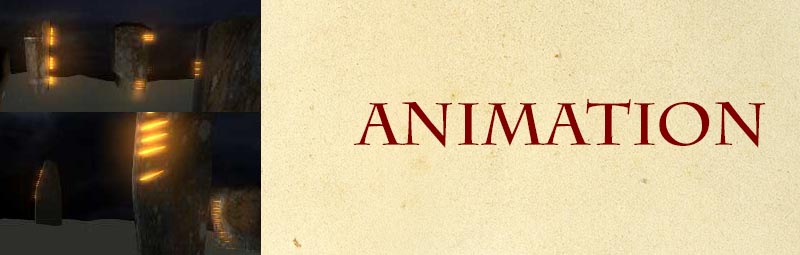
My original idea for an animation about Ogham Stones, was to create a virtual world, where Ogham Stones that have been relocated, could be returned to their original site in a virtual world. This could be applied to Ogham Stones, in Museums and other collections. An example of this is the Ogham Stones from Ballinrannig, Co, Kerry. In the late 1700’s a collection of seven Ogham Stones and a cross slab were revealed in Ballinrannig, Smerwick Harbour, Co. Kerry, when a storm shifted the sand covering them. Lord Ventry, of Burnham House, moved six of upright Ogham Stones, and a cross slab. He placed four of the stones along with the cross slab in his driveway.
(Digital Literacies) A Pedagogy
The cultivation of learning is a cognitive and emotional and social activity [Illeris 2002]
Investigation and identification of digital literacy activities, since the inception of the world wide web and personal computers, has been the concern of numerous researchers. The need for mastering electronic tools, ability to plan, execute and evaluate digital actions; these skills are now considered crucial [Fieldhouse & Nicholas 2008, Martin 2003].
Digital Literacy
As discussed in a previous article, Digital Literacies is one of the nine themes of Engaged Digital Citizenship. I wrote only briefly about it though, as it is a complex theme in itself and it warranted having its own article. Of all the nine themes of Engaged Digital Citizenship, Digital Literacy has the most meaning and potential to facilitate knowledge, ideas and communication in community based digital projects. In order to be able to research the benefits and obstacles within digital community-based projects, it is essential to understand what Digital Literacy means: with regard to the practical, pedagogical and lifelong learning. In this article I will discuss why we need to know about digital literacies.
Engaged Digital Citizenship
In my quest for the holy grail of knowledge; how individuals, community-based projects and digital technologies can positively facilitate each other, I am researching ‘engaged digital citizenship’. To truly understand how individuals can become digital citizens, I am looking at the policies and research on the subjects of engaged digital citizenship, including digital communications, digital literacies and digital health and well-being. By being acutely aware of the themes of Digital Citizenship, I can gauge better the successfulness of a digital praxis in a community-led project.
Metadata
I’m starting to think that next big innovation online, other than ‘Big Data’ (the relation of massively huge sets of data to one another to make deeper insights possible), is ‘Meaningful Data’. 1
Note: This quote by Louis Jordan, is more accurate a description about Web 2.0 that we realise. Huge quantities of data files are being uploaded to the internet every day. Latest statistics from YouTube say 60 hours of video are uploaded every minute. With cloud storage being offered for low prices, we are gathering digital data at an incredible rate, which not only questions, do we need to store all this data, but, how are we going to find anything ever again? Do a search on Google theses day, you rarely get what you are looking for. Unless you know how to search. I’ve become an expert at searching, I though it was because, I was just becoming more saavy, until I realised, I was, unknowingly becoming more metadata aware. I have been trying to get round to learning more about metadata, and how it can be used for my research, but then I realised it should not be just for research. Metadata is for Life!
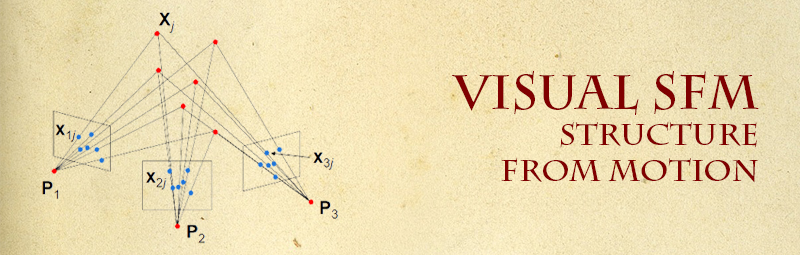
Visual SfM: 3D Construction through Structure from Motion
From reviewing the paper The Untapped Potential of Low Cost Photogrammery in Community-Based Archaeology, it was easy to see that photogrammetry can be used as an alternative to high resolution surveying with high costs.
Traditional softcopy photogrammetric methods require the 3-D location and pose of the camera(s), or the 3-D location of ground control points to be known to facilitate scene triangulation and reconstruction. In contrast, the SfM method solves the camera pose and scene geometry simultaneously and automatically, using a highly redundant bundle adjustment based on matching features in multiple overlapping, offset images [Westoby et al 2012].
Structure from motion is the geometry of creating 3D models from 2D images. If you are interested in the maths behind SfM, visit Prof. Rob Fergus’s lecture notes on Computer Vision, or geometric vision, in particular Lecture 6 on Multiview Stereo & Structure from Motion. It is quite interesting to see the process. Thankfully, to Wu Changchang, we don’t need to understand the mathematics behind how Structure from Motion works, to be able to use it. In his post-doc year at University of Washington Seattle, he developed Visual SfM.
Review: Toward Virtual Community Knowledge Evolution
Note: In looking for articles to read, to understand better the mechanics and possibilities of digital technologies that can improve communities both online and offline, I came across this paper, ‘Toward Virtual Community Knowledge Evolution’. Published in 2002, and with the extraordinary rate at which digital technologies change, it seems outdated. However I see it as a classic. The beginning of the road towards collaborative technological advances, and the real value of digital technologies. It was a vision for the future, for digital technology to facilitate knowledge, which meant devising new systems, that would engage and enable users in digital literacies associated within their virtual community. A lot of these features we now take for granted, such as hyperlinks, but in studying the classics, we can realise the excitement as these new systems were developed by people, for people.
Introduction
Toward Virtual Community Knowledge Evolution is a study carried out by a nine academics, Michael Bieber, Douglas Englebart, Richard Furuta, Starr Roxanne Hiltz, John Noll, Jennifer Preece, Edward A. Stohr, Murray Turoff and Bartel Van De Walle, who lecture in a range of universities, all working and excelling in their areas of computer science and information systems. In this paper, they propose the building of a ‘multimedia document repository’ or digital library, which has unique innovate supports which validates knowledge evolution. A series of tools and technologies based around the concept of community knowledge that can be build-on collectively, to constantly improve the workings of the system. This system, or Collaborative Knowledge Evolution Support System (CKESS), would provide a workflow that can be developed and upgraded through its users; the members who make up the virtual community.