:::: MENU ::::
Browsing posts in: Journal

Digitally Remapping Ireland’s Ordnance Survey Heritage

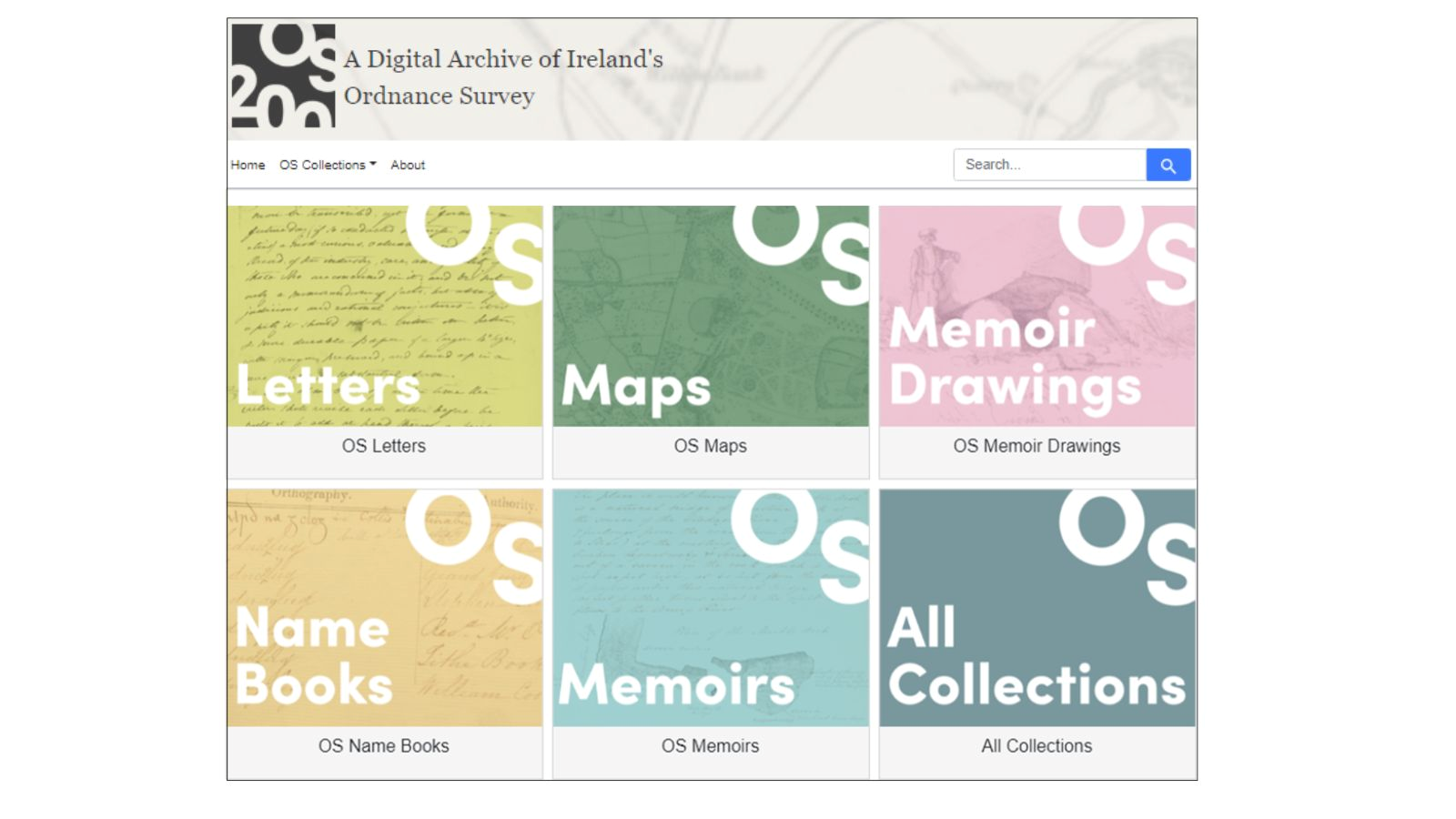
screenshot of the Digital Archive of Irelands Ordnance Survey, with bozes saying letters, maos, memoir drawings, name books, memoirs, all collections

Nineteenth-century Ireland was the first country to be entirely and systematically mapped at a scale of six-inches-to-one-mile. The British military-led Ordinance Survey team traveled across pre-famine Ireland gathering a range of information, including geographical, archaeological and toponymical information including local customs, antiquities, and place names.

“These records capture the pre-famine landscape of localities across the island as they were in the 1820s and 1830s, including farming practices, language, folklore, trades, and religion, as well as details of the lives and activities of those employed by the OS in Ireland. 

The cultural complexities of the OS in Ireland are recorded in a variety of source materials, not just maps. In various archives, museums and repositories across Ireland and Great Britain lie correspondence, statistical accounts, drawings and sketches, and comprehensive placenames, providing a pre-famine record of Ireland and its population. 1.”

The OS200 project is led jointly by Dr Catherine Porter at the University of Limerick (UL) and Professor Keith Lilley at Queen’s University Belfast (QUB), bringing together a cross-disciplinary team of geographers, historians, archivists, linguists, archaeologists, computer scientists, and digital specialists; their varied interests and specialisms helping inform the creation of a project database and online resource. 

OS200 is a multi-project that aims to gather historic Ordnance Survey (OS) maps and texts, currently held in disparate archives, to form a single freely accessible online resource for academic and public use. 2

But why are these historic maps relevant? During the mapping of Ireland, the surveyors gathered a significant volume of other materials including letters, notebooks, memoir drawings, and place name books. The gathering of these resources in one single digital repository is opening up new thoughts and ideas of what the mapping process meant to Ireland at the time, its landscape and its society. Different iterations of this state ordnance survey can reveal a lot, not just from what is there, but what is not there.
Continue Reading


European Public Domain Day 2026

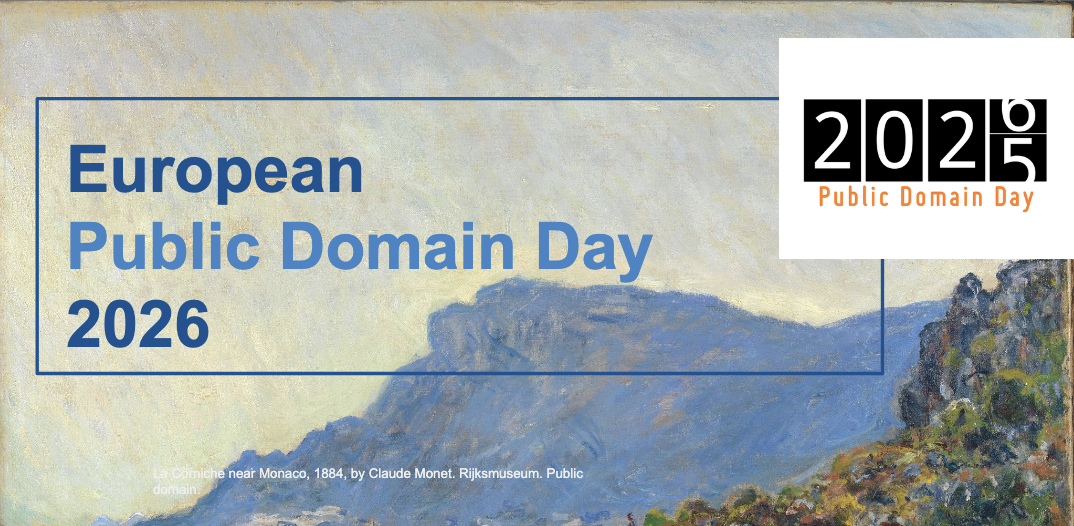
graphic containing text saying European Public Domain Day 2026, over a painting by Claude Monet.

European Public Domain Day is an annual event that celebrates the Public Domain. A number of European institutions and organisations come together to highlight the public domain, celebrating new works being released, but also discussing different types of legal, technical, financial, and institutional barriers that prevent public access, even after copyright protection ends.

In 2026, this celebration took place online and in-person on the 15th of January in Brussels, in the Royal Library of Belgium (KBR), with numerous partners, local and international. I was one of 3 people sponsored to attend, and it was such a privilege to get off the island and join mainland Europeans, on this jam-packed insightful day listening to discussions on all the things I love: heritage, community, open source and open access. 

Continue Reading


January 2026 – what’s happening?

I haven’t checked into this blog in a while and I’ve discovered multiple half-written unpublished posts since starting my job on the LIVE Project. That was over 5 years ago. Scary. I swear the earth is turning faster, that can only explain the lapse in my perception, between my time, my intentions and my actions, in trying to keep this website alive and updated.

It’s now January 2026, and I am reviving this little blog, because I am about to embark on the journey of a lifetime, for me anyway. I have been accepted to do a PhD in Public Humanities with the University of Limerick, and I will be blogging about this journey here. Wish me luck!


Continue Reading


The LIVE operation (Llyn IVeragh Ecomuseums)

This week I am starting a new position, Research Support Officer, Local Operations Coordinator – with the School of BEES/ERIS, UCC. The LIVE operation (Llŷn IVeragh Ecomuseums) is a multi-partner venture that will establish an EcoMuseum in western Iveragh, Co. Kerry, and will develop a new pillar for the #Ecoamgueddfa of the Llŷn Peninsula in Wales.

LIVE will promote tourism using the EcoMuseum model and through co-operative marketing of natural and cultural capital assets to bring tourists into the regions outside of the traditional peak tourist seasons, enhancing the consequential socio-economic benefits to the coastal communities.

https://irelandwales.eu/projects/live-llyn-iveragh-ecomuseums

Part of the Ireland Wales Cooperation Programme, that has seen numerous projects happen over the past few years. I’ve been following a few on Twitter with interest, I am delighted I will now get to work on one of the babies of this programme. The main focus of the operation is to maximize the potential of local natural heritage as a tourism asset, “developing and enhancing the quality and impact of ecotourism in the participating coastal communities”.

As the project progresses, I’m going to write a series of generalized blogs about EcoMuseums, sustainable tourism, research tools, etc. I won’t be writing about the project particulars, unless they are publicly advertised (GDPR and all that), but an overview, more of a digital diary, where I can log tools and methods used to research and develop this project.

I am delighted to be taking part in this project, and very excited about the potential of this EcoMuseum for South Kerry


Lean UX

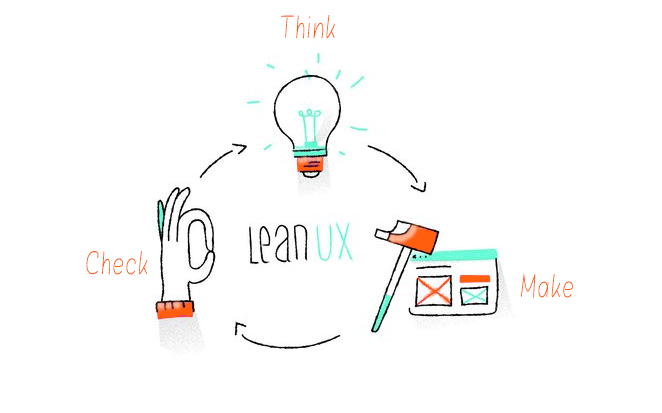
diagram of the Lean UX process

I’ve just handed in my final assignment for a Certificate in Lean UX, with the Institute of Technology Tralee. This course was due to be run in situ, earlier in the year, but due to a number of reasons, including the Covid19 pandemic, it was rescheduled to run remotely over 2 jam packed remote workshops, with a serious amount of research work to build up a case study assignment.

Continue Reading


Diploma in Software Development

graphic contining several file extensions

The past 7 months have been somewhat of a crazy blur. Not because of the unprecedented Covid19 pandemic we are living through, but because I have been crazy busy, adding new tools to my digital toolbox.

Last year, by October, I had finished 2 big contracts, that were my bread and butter money. Even before the pandemic outbreak started, I realised there just wasn’t enough work for me locally, and I needed to reach out into the remote working world more. I am used to working remote, but the majority of my clients are local. So I decided to take a week’s break, and really sit down and think about my future.

Continue Reading


Coders Tears

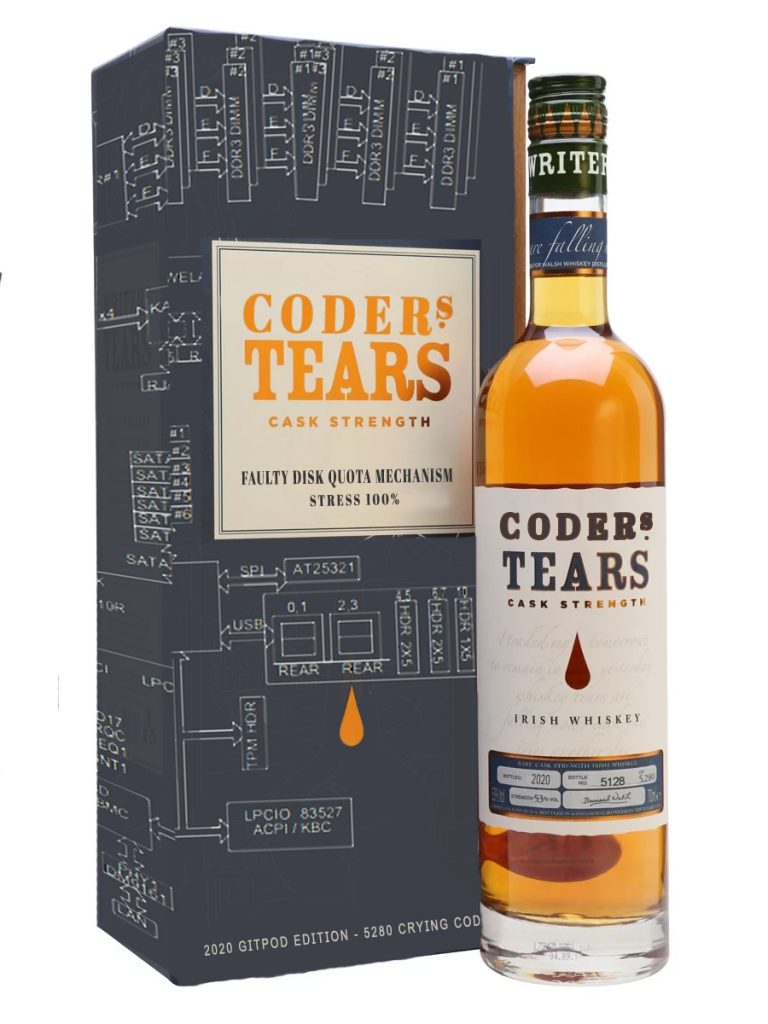
bottle and bog of writers tears whiskey edited to say coders tears
In remembrance of the ‘Great Faulty Disk Quota Mechanism’ of 2020, a Gitpod outage, that caused thousands of unsuspecting coders to loose a few hours of their work. Thankfully I was more in design mode than coding, so I just lost a wee bit of work, but the tears of my fellow coders were felt.
 
The first thing that came to my mind was ‘Writers Tears’ whiskey, as there is nothing more likely to drive you to wanting a stiff drink, than loosing your work.  I made this image as a joke to send to my fellow coders. They were not quite amused (give it time).


Has Digital Technology made us less curious?

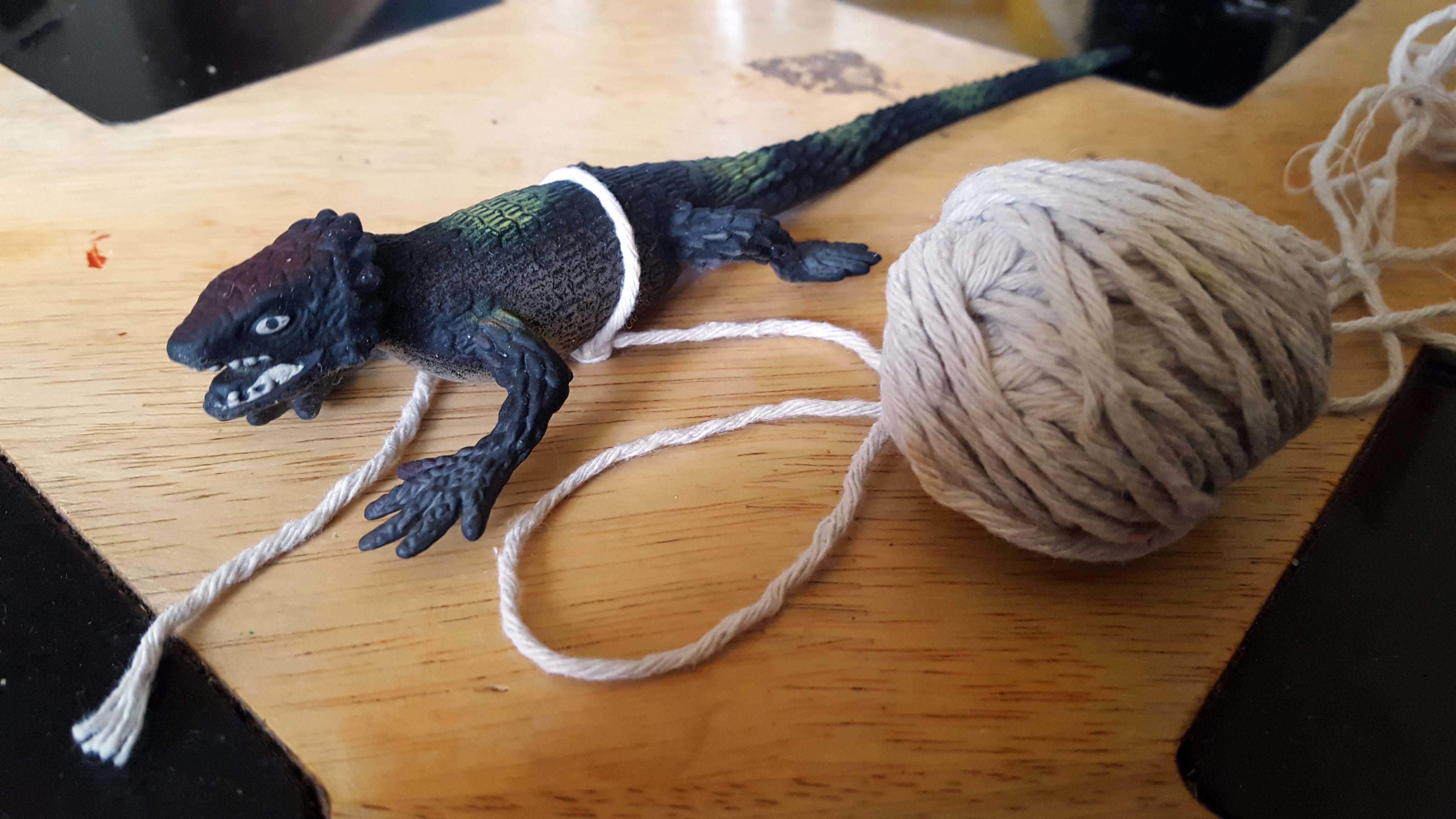
using a toy lizard to demonstrate a pendulum

There have been 2 events this week that made me think about digital technology. [Digital Technology in a vague modern term, from smart phones to digital cooking scales].

First I must explain the picture above. This is my attempt at explaining a pendulum to my 11yr old son. He wanted to know why I was going on and on about women’s rights and marches and other womeny things these days, and I was trying to explain that long-term oppression can cause an equally wild reaction. As in the swing of a pendulum. Women have been oppressed for so long, we need revolutionary action (non-violent subversive stitching, is as revolutionary as I get) to get the pendulum swinging against patriarchy. It will swing wildly at first, and then, naturally find its own balance. I believe this of all kinds of oppression fall under Newtons Third Law –For every action there is an equal and opposite re-action. And/or perhaps karma.

Continue Reading


Finished!

generic image of hats being thrown in the air for a graduation celebration

The long delay between this post and the previous post is because I finished my MA in Digital Culture! (Successfully, thankfully). I handed in my Thesis, and then the following day hopped on a plane for a few weeks holidays.

Since returning, I have been to a few conferences, started working, researching, and have had several interesting conversations, that should have been blogged here. I do want to keep the blog going as its a great method for researching, writing and putting thoughts to keyboard. So, I will catch up in due course.


Learning as Hyperbolic Chaos

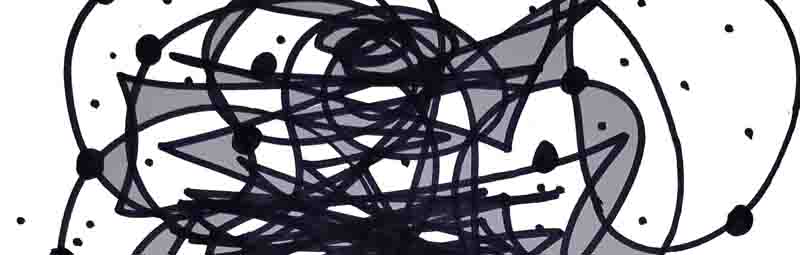
image of scribbles

Just a few weeks before my MA thesis was due, I was researching for diagrams of learning models, in particular related to Digital Literacies. I had an idea of a model in my head, but I couldn’t seem to find one that suited what I was trying to say.  I wanted to find a learning model that was not angular,  A > B, or cyclical, A > B > C > A > B > C…… Of course, new lines of thought, are not a good idea in the last few weeks of a thesis, but it was a nagging one and I had to explore it, albeit briefly. In my thesis, it was just a brief paragraph.

Continue Reading


Pages:12345›
css.php