
European Public Domain Day is an annual event that celebrates the Public Domain. A number of European institutions and organisations come together to highlight the public domain, celebrating new works being released, but also discussing different types of legal, technical, financial, and institutional barriers that prevent public access, even after copyright protection ends.
In 2026, this celebration took place online and in-person on the 15th of January in Brussels, in the Royal Library of Belgium (KBR), with numerous partners, local and international. I was one of 3 people sponsored to attend, and it was such a privilege to get off the island and join mainland Europeans, on this jam-packed insightful day listening to discussions on all the things I love: heritage, community, open source and open access.

The Public Domain is the collection of all creative works that are no longer covered by intellectual property rights, such as copyright and related rights. Sounds simple? Its not exactly.
In the EU, copyright protection expires 70 years after the death of the the creator, artist, writer, director, poet, etc. This change in legal status, however, doesn’t automatically mean the material becomes accessible. It can be more complicated than it seems, with different rules for different mediums and different countries. Even different countries within the EU may have different rules due to ownership rights, co-creators rights, legal extensions to copyrights, and for example, in France a war time extensions.
There are many European institutions and organisations working independently and collaboratively on issues of the public domain, and European Public Domain Day is an opportunity everyone to come together, not just to celebrate the existence of the public domain and new works being released, but also to highlight, as I mentioned previously, barriers to public access. During the course of the day I heard of several barriers including legal, financial, and technical obstructions that can prevent public access, and how organisations are constantly trying to come up with new ways, new legal interpretations, and new tools for open source access.

European Public Domain Day 2026 was opened with moderators Camille Françoise (Lecturer at Université d’Artois and board member of Wikimedia France) and Bart Magnus (meemoo), who were both so warm and welcoming, sounding very relaxed, despite the energetic programme they had put together for the day. As the conference was also available to attend online, it was recorded and can be viewed on Vimeo, with great photos by Sebastian ter Burg available on Flickr.
The keynote began with Bartolomeo Meletti of CREATe. Based in Glasgow, The Centre for Regulation of the Creative Economy, is a think tank of sorts anchored in intellectual property, competition, information and technology law – new business models in the creative economy. Bartolomeo spoke about the origins of the Public Domain, and of the barriers to accessing cultural heritage. Only 1% of cultural heritage in institutions archives are actually available online for public access. So sometimes its not that access is denied intentionally, it can be down to technical and financial difficulties on the part of the cultural institute through an interactive old style gaming console and multimedia screen.
Following on, Brigitte Vézina, Director of Policy and Open Culture with Creative Commons talked about how the public domain is a fundamental principle of copyright law. The ‘fuzzy legal and policy issues’ that stand in the way of access, are detrimental to creativity, research, education and cultural participation. The use, re-use and remix of culture, information and knowledge should be the norm, and copyright, the exception. She called on organisations to sign the Open Heritage Statement, a collective call for equitable access to heritage in the public domain, a call to action to promote open access through shared advocacy and practical solutions.
Internet Archive Europe has been preserving European digital materials since its founding in 2004 in the Netherlands. Beatrice Murch spoke about the work of the Internet Archive in Europe, working with dozens of European libraries and government agencies to build web collections, prioritized collaboration with cultural heritage organizations to safeguard our collective history. She talked about projects that can help bring these collections to life, highlighting Websites van Nederland, an innovative project with the National Library of the Netherlands that makes decades of Dutch web history tangible and explorable for the public through an interactive physical platform using an old gaming console and multimedia screen.

After these talks, the group broke into a Belgium and a English speaking European track.
Digital Omnibus
Leander Nielblock of COMMUNIA, spoke about the “The Digital Omnibus“. COMMUNIA is an advocacy group for policies that expand the public domain and increase access to and re-use of culture and knowledge. The Digital Omnibus is a set of technical amendments to a large corpus of digital legislation, that is supposed to bring “immediate relief to businesses, public administrations, and citizens alike, and to stimulate competitiveness”. while in reality the planned changes to the data protection regime goes beyond privacy rules. “One amendment to the Open Data Directive in particular could have serious consequences, potentially undermining open projects such as the Wikimedia projects”. Currently the Open Data Directive operated under the principle that “the re-use of documents shall be free of charge” (Article 6(1)), but these new changes can allow “large corporations can free-ride on open knowledge to strengthen their market position and, ultimately, their control over public goods”. Read more about the Digital Omnibus here.
Commons DB
When using imagery from cultural instructions, it is standard practice to name your source with the creative commons licencing system, showing what licence you are using in reproducing the image. But when using an image, where did that image really originate, and are you sure you are using the correct licence?
Paul Keller (OpenFuture Foundation) works on a project called CommonsDB which is looking to advance the registry for Public Domain and openly licensed works. He showcased CommonsDB Explorer—the first public interface for the prototype registry of Public Domain and openly licensed works, it does this by tracking the metadata of the image.
You can instantly see what is the correct licencing for the image.
CREATe
CREATe, mentioned earlier, hosted an engaging academic panel to discuss empirical and theoretical research on the public domain, with a view to informing evidence-based policy and practice. It included with Kristofer Erickson, Martin Kretschmer, Aline Iramina, Bartolomeo Meletti and Séverine Dusollier, with lots of contributions from the audience for the Q&A.
Tapestries
Tapestries is a free open source tool enabling anyone to assemble non-linear multimodal presentations comprised of web pages, PDFs, graphics, audio and video files, and even code running in emulators. Developed by Bob Stien, a publisher with The Institute of the Future of the Book, “a small think-and-do tank investigating the evolution of intellectual discourse as it shifts from printed pages to networked screens”. Bob has been at the forefront of electronic publishing, and was the first to publish a commercial CD Rom, and an electronic book, including Douglas Adams’s Hitchhikers Guide to the Galaxy. Bob spoke about his work developing Tapestries and gave a demonstration on its uses. I attended a workshop with Bob on using Tapestries in the afternoon, and it is definitely deserving of its own blog post.
The Graveyard Shift: Public Engagement, Copyright, Death Dates and Data
After a lovely lunch, Annabelle Shaw & Louise McAward-White of the British Film Institute, spoke about the difficulty of copyright laws within film archives. As a lot of films are made collaboratively, director, screenwriter, sound production, etc, copyright can be difficult to establish using the ’70 years about death’ copyright law. It was a hugely informative talk about the day to day difficulties with archiving, metadata and copyright relating to their vast collection. They talked about a public engagement initiative they run called “The Graveyard Shift”, a series of public research events to find death dates of key people involved in filmmaking roles, to enhance the archives data and knowledge of copyright in their collections. They look through a variety of online sources, trawling through death registries, parish archives, local news media and more. I spoke to them after their talk, on using the archives for historical research of events in Ireland, as I did not realise their archives were so extensive. It’s a very exciting prospect.
Pattern-a-thons
Pattern-a-thons is a crowdsourcing event to find new ways of creating and sharing fashion heritage more widely. A series of events that invited participants to recreate patterns from pieces in the study collection, with the purpose of making them open source through Wikimedia Commons. Dieter Suls, coordinator with the MoMu Fashion museum in Anterp, talked about a series of open community events they organised to create living history patterns from clothes in their collection. He spoke about the iterations they ran of the event, each time gaining knowledge, new skills and understanding what tools were needed for creating these open source patterns. After some failures, they onboarded Stijn Van den Bulck, as a pattern cutter, to make sure the patterns were more accurate, following international measurements and guidelines. The initiative is working to uncover and recover patterns, engaging students, designers and researchers in enriching Wikipedia through creating patterns of fashion objects. The can be viewed here on Wikimedia Commons.
I spoke with Dieter and Stijn during the next coffee break, excited to learn more. Ireland has such a rich heritage in textiles, (as a former weaver, I am naturally biased), and yet we still don’t have a dedicated museum or textile centre. But, there is plans afoot for a new Limerick Museum of Fashion, to house both lace collections and the Sybil Connelly collection. So, no doubt there will be some great opportunities for collaboration and knowledge exchange there.
EPIC-WE: Empowering participation through ideating Cultural Words and Environments
Carlo Gaetano, a curator at the Dutch audiovisual archive, (University of Amsterdam) and Wytze Koppelman, an Italian artist and researcher, (Beeld & Geluid) talked about EPIC-WE: Empowering participation through ideating Cultural Words and Environments. They collaborated on a multi-partner project to run a youth game jam, remixing heritage to think about climate scenarios, and in this instance to imagine future sea-level rise scenario, and its effects on our environment and society.
[A game jam is an event where participants try to make a video game from scratch. Depending on the format, participants might work independently, or in teams. Traditionally, game jams focus on video games; however, board games have also been the subject of game jams. Wikipedia].
Happy accidents with Public Domain videos
Björn Wijers, is a freelancer who works regularly with Public Spaces. He showcased one of his personal projects, a series of sound and film shorts, where he embraced his inner child, tinkering with material in the public domain, simply for fun; no best practices, no standards, and doesn’t have to be monetized. He made these for Jamuary – a global crowdsourced project to create a jam each day in January and share the results online.
Wiki Love Public Domain 2025
Geert Van Pamel & Maarten Zeinstra talk about the Wiki Love Public Domain 2025, the first annual competition to create and improve public domain representation. Similar to other Wiki Loves events, their goal is to document, preserve and promote works of creation that are in or entering the public domain. Wiki Ireland hosts a Wiki Loves Monuments photography competition annually, and its a fantastic project to be involved with, to update Wiki commons with new photos from Ireland each year.
Closing Session
Bart and Camille closed off the event with thanks to everyone for a fantastic day, and invited all to join for drinks after to celebrate English Wikipedia’s 25th anniversary.
If you have any interest in any of the topics, you can watch the videos here

And I’d like to say thanks again, for the sponsorship of my trip to Brussels to attend the event. Living in Ireland, especially in the rural south west, I follow developments in cultural heritage as much as I can but always feel one step removed. Europe feels so far ahead of us, culturally, technically, and we lag behind because sometimes you just need to be in the room, having that cuppa and chat. We can’t just casually hop on a train and cross borders, be inspired by fantastic new digital exhibitions*.
Our ‘islandness’ is our culture, but it can perhaps cause a slowness in cross border cultural heritage institution collaboration, it could be financially difficult, but also the carbon footprint of travel needs to be take into account, on whether you actually need to be in the room or not.
In this instance I was so glad to be there, I feel renewed faith in European cultural institutions and organisations, the unseen fights for funding and access, against the corporatization of our cultural heritage, and the EU MEPs and civil service kotowing to big tech and the AI theft.
An inspiring few days.
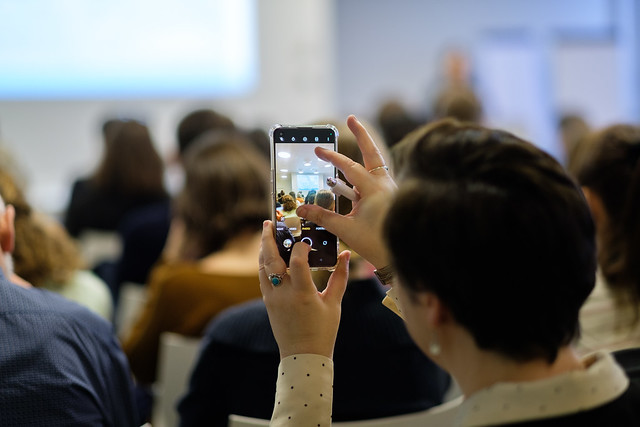
Picture of me taking a photo of speakers at the conference.
Photo by Sebastian ter Burg, Europeana EU, lots more on Flickr.

Nederlandse Spreekwoorden/Netherlandish Proverbs - 1559 oil-on-oak-panel painting by Pieter Bruegel the Elder that depicts a scene in which humans and, to a lesser extent, animals and objects, offer literal illustrations of Dutch-language proverbs and idioms. Public Domain. Wikepedia
* I sat in the Bruegel Box for a long time. To celebrate the 450th anniversary of Bruegel’s death (in 2019), The Royal Museums of Fine Arts in Belgium, the other museums in Europe who hold Bruegel’s work, together with Google Arts and Culture, created the ‘Bruegel Box’. A collaboration between art and technology, you can sit and enjoy 7 immersive videos – each dedicated to one painting – projected on three walls, floor to ceiling. You can watch more about this process on YouTube.
A digital collaboration between Come face to face with the characters from Proverbs (1559), The Sermon of Saint John the Baptist (1566) and The Fall of the Rebel Angels (1562), Winter Landscape with a Bird Trap and Skaters (1565) and the Census at Bethlehem (1566).

So, what do you think ?